Case Study - Building a Headless CMS for Google Firebase
The leading headless Content Management System built for Google Firebase.
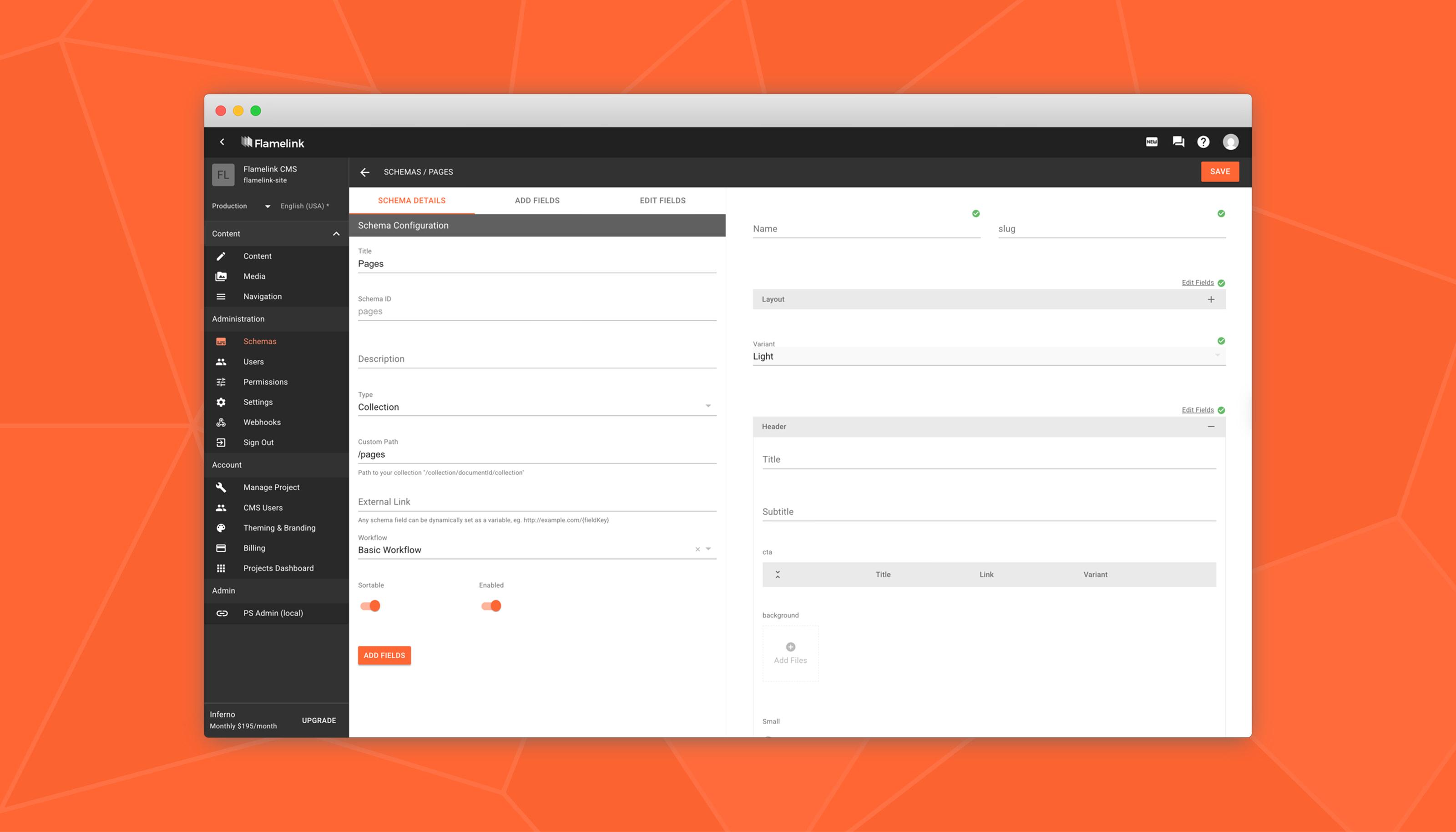
We built the entire Flamelink CMS platform from the ground up — a powerful, configurable content management layer that integrates deeply with Firebase Authentication, Realtime Database, Cloud Firestore and Firebase Storage.
Highlights
- Google Firebase CMS
- #1
- Active Users
- 20,000+
- Platform Uptime
- 99.99%
- Global Coverage
- 90%
- Built From Scratch
- Ground Up
- Full-Stack Development
- Cloud Architecture
- SaaS Platform
- Firebase Integration
- UI/UX Design
- DevOps & CI/CD
- Realtime Database
- Cloud Firestore
- Firebase Authentication
- Firebase Storage
- Content Management
- SDK Development
- Stripe Payment Integration
Client Overview
Flamelink is the leading headless Content Management System (CMS) purpose-built for Google's Firebase platform. It provides a powerful, configurable, no-code interface that layers directly on top of an existing Firebase project, enabling both developers and non-technical content teams to manage content, files, media assets and users — without writing backend code.
What makes Flamelink unique in the headless CMS space is its Firebase-native architecture: all content is stored directly in the user's own Firebase project (Cloud Firestore or Realtime Database), and all media is managed through Firebase Storage. Users retain full ownership of their data at all times. There is no separate backend to provision or maintain — the platform inherits Firebase's serverless, auto-scaling infrastructure backed by Google Cloud Platform.
We were engaged to build the entire Flamelink platform from the ground up — from initial architecture through to a production-grade SaaS product serving a global user base.
The Challenge
Building a headless CMS that deeply integrates with every core Firebase service presented a unique set of engineering challenges:
- Multi-Database Support: The platform needed to support both Firebase Realtime Database and Cloud Firestore as first-class storage backends, allowing users to choose or switch between them. Each database has fundamentally different data models, query capabilities and real-time sync behaviours.
- Firebase Authentication Integration: User access control had to be tightly coupled with Firebase Authentication, ensuring secure, role-based access to the CMS while respecting the user's existing auth configuration.
- Firebase Storage Management: Media and asset management needed to work seamlessly with Firebase Storage, handling file uploads, transformations, relational data mapping and bucket management across both client and server environments.
- Schema-Driven Content Modelling: The system required a flexible, drag-and-drop schema builder that could generate complex content types in minutes — supporting multi-language content, multi-environment publishing and custom workflows.
- Scalability & Reliability: As a SaaS platform serving a growing global user base, the architecture had to deliver enterprise-grade uptime and performance without requiring users to manage any infrastructure.
- Developer SDK: An official JavaScript SDK was needed to give developers programmatic access to content, with support for relational data resolution, media mapping, and compatibility with both the Firebase client SDK and Firebase Admin SDK.
Our Approach
We took full ownership of the product engineering lifecycle — from architecture and design through to development, testing, deployment and ongoing platform maintenance.
1. Architecture & System Design
We designed a Firebase-native architecture where the CMS acts as a management layer on top of the user's own Firebase project. This meant every piece of content, every media file and every user permission lives in the customer's Firebase infrastructure — not ours. The architecture was built to be serverless from day one, leveraging Firebase's auto-scaling capabilities and Google Cloud Platform's global infrastructure.
A key architectural decision was building an abstraction layer that normalises operations across both Realtime Database and Cloud Firestore, allowing the entire CMS feature set to work identically regardless of which database backend a user chooses.
2. Core Platform Development
We built the CMS interface as a rich, single-page application featuring:
- Visual Schema Builder: A drag-and-drop content type builder enabling users to create custom schemas with complex field types, validation rules and relational references.
- Multi-Language Support: Full internationalisation support allowing users to manage content in any language and take their applications to market globally.
- Multi-Environment Publishing: Content staging and promotion workflows that let teams test content in development or staging environments before pushing to production.
- Granular Permissions & Roles: Advanced role-based access controls restricting users to specific content types, actions and environments.
- Custom Workflows: Configurable content workflows (draft, review, approve, publish) tailored to each project's editorial process.
- Webhooks & Event Triggers: Configurable event-based triggers with customisable notification delivery for integrating with external services and automation pipelines.
3. Firebase Service Integration
Each core Firebase service was deeply integrated:
- Firebase Authentication: Seamless user management and access control, supporting all Firebase auth providers.
- Realtime Database & Cloud Firestore: Full read/write support with real-time sync, complex queries and automatic data validation.
- Firebase Storage: Complete media management including uploads, folder structures, metadata handling and automatic URL resolution across client and server environments.
- Firebase Security Rules: The platform leverages Firebase's native security rules for both database and storage, providing enterprise-ready security out of the box.
4. SDK & Developer Experience
We developed the official Flamelink JavaScript SDK, providing developers with a clean API for accessing CMS content programmatically. The SDK handles automatic relational data resolution (populating referenced entries), media data mapping (resolving file references to storage URLs), and works seamlessly on both client-side and server-side (Node.js with Firebase Admin SDK).
5. DevOps, Monitoring & Reliability
We implemented comprehensive CI/CD pipelines, automated testing, monitoring and alerting to maintain the platform's 99.99% uptime target. Infrastructure is secured with encryption at rest and in transit, DDoS protection, and daily encrypted backups on Google Cloud Platform.
Results
The Flamelink platform has grown into the leading Firebase CMS, delivering measurable impact:
- 20,000+ active users managing content through the platform globally.
- 99.99% uptime maintained consistently, meeting enterprise-grade SLA requirements.
- 90% global coverage with users spanning nearly every region on the planet.
- Dual database support — the only CMS offering first-class support for both Firebase Realtime Database and Cloud Firestore.
- Official Firebase ecosystem partner, recognised as the go-to CMS for Firebase developers.
- Framework-agnostic delivery — content served to web, mobile, IoT, AR/VR and any platform Firebase supports, via the official JavaScript SDK.
- Enterprise-ready security with GDPR compliance, encryption at rest and in transit, and DDoS protection. You always own your data and have full access to it — everything lives in your own Firebase project.
From a blank slate to a globally adopted SaaS product, we delivered a platform that bridges the gap between Firebase developers and content teams — enabling them to work independently while keeping all data securely within the user's own Firebase project. Flamelink stands as proof of what is possible when deep technical expertise meets thoughtful product design.